
Short answer: no. LeetCode-style rounds won't disappear in the next twelve months. They are losing their monopoly, though.
What's changing is that a pure algorithm round now gets paired with, or replaced by, a round where you work inside an existing codebase with an AI assistant. Meta, Canva and Shopify run these rounds today. Amazon allows an AI assistant in some online assessments, and Google is piloting one. Early-stage startups moved first and furthest. Big Tech still keeps at least one classic round for most levels, and mass hiring in India still runs on online DSA and aptitude tests.
Below is what the evidence shows, then my rough odds for the next year. Every probability in this post is my own estimate from the sources at the bottom, not a number from a survey.
What already changed, by date
The shift happened at named companies, and you can date it. In 2025 the moves were mostly about stopping cheating. In 2026 companies started allowing AI in the round itself.
- June 2025, Canva. Canva replaced its Computer Science Fundamentals screen with an "AI-Assisted Coding" interview for backend and frontend roles. Candidates are expected to use Copilot, Cursor or Claude. Their engineering blog says "AI assistants can trivially solve traditional coding interview questions."
- 2025, Shopify. Head of Engineering Farhan Thawar told The Pragmatic Engineer the company is "embracing" AI in interviews and expects AI to do roughly 90 to 95 percent of an engineer's work, with the engineer reviewing and understanding it.
- July 2025, Anthropic. Anthropic loosened its May 2025 ban. Candidates can use Claude to polish applications and prepare, but live interviews stay AI-free unless the interviewer says otherwise.
- August 2025, Google. After Sundar Pichai said "some fraction of the interviews" should be in person, Google moved to bring back face-to-face rounds. McKinsey, Deloitte and Cisco did the same for some roles.
- October 2025, Meta. Meta started replacing one of its two onsite coding rounds with a 60-minute AI-assisted round in CoderPad. You inherit a multi-file codebase with tests and have to build, extend or debug it. E6 and below still get one traditional round. E7 and above only get the AI-assisted one. This comes from candidate reports, not an official Meta document.
- January 2026, Amazon. Amazon allows an on-platform AI assistant in SDE technical assessments, according to a compiled list that cites About Amazon.
- May 2026, Google. Business Insider reported on an internal document describing a "human-led, AI-assisted" coding pilot with Gemini for junior and mid-level roles on select US teams. A Google spokesperson confirmed candidates in the pilot use Gemini. Google's public careers policy still says AI isn't permitted in interviews.
- October 11, 2026, HackerRank. HackerRank, one of the companies that built the puzzle-test industry, put up San Francisco billboards reading "Sorry, we made you grind LeetCode" to sell Chakra, an AI interviewer built around candidates using AI on realistic tasks.
That billboard matters more than its marketing tone suggests. The vendors selling assessments to thousands of employers are now selling the AI-assisted format. Mid-size companies rarely write their own tests, so when the vendor default changes, their interviews change with it.
Why it's happening
Two pressures push the same way. AI tools solve standard algorithm questions, so a remote LeetCode round no longer proves the candidate can solve them. And the job itself now involves directing and checking AI output, so the old round tests a skill that matters less than it used to.
You can measure the cheating side. In a 2025 interviewing.io survey of 63 interviewers, reported by The Pragmatic Engineer, 81 percent of Big Tech interviewers suspected candidates of using AI to cheat. 31 percent had caught one in the act, and 58 percent had changed their questions. Gartner's survey of 3,000 candidates found 6 percent admitted to interview fraud, and Gartner predicts that by 2028 one in four candidate profiles worldwide could be fake. Karat's survey of 400 engineering leaders found 71 percent say AI makes technical skills harder to assess.
The same Karat survey shows nobody has settled on an answer. In the US, 38 percent of leaders said they allow AI in interviews, while 62 percent of organizations overall prohibit it. Chinese companies allow it far more often.
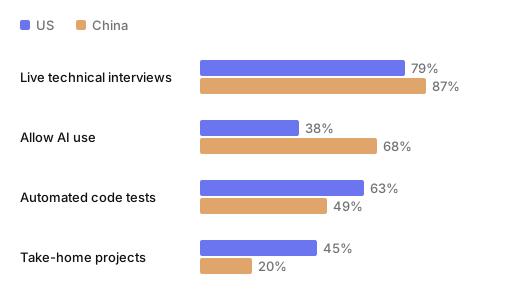
Live technical interviews are still the norm, and only about a third of US leaders allow AI in them. Source: Karat, Engineering Interviews in 2026, survey of 400 engineering leaders in the US, India and China, Jan 2026.
What the people at the top are saying
Elon Musk never ran his companies' hiring on puzzle scores, and his 2026 statements lean even harder toward judging what a person has built. On May 21, 2026 he asked for engineers and physicists for SpaceXAI "even if you have zero prior experience in AI," and told them to email "~3 bullet points demonstrating evidence of exceptional ability." He added that making "a very complex thing do useful work" is a major plus. On the Collison and Patel podcast, as reported by Fortune, he put it bluntly.
"Don't look at the résumé. Just believe your interaction."
Elon Musk, CEO of Tesla and SpaceX, on the Collison and Patel podcast, 2026
Sundar Pichai points the other way on format. He isn't dropping fundamentals. He wants to check them in person.
"Given we all work hybrid, I think it's worth thinking about some fraction of the interviews being in person."
Sundar Pichai, CEO of Google, on the Lex Fridman Podcast, June 2025
"We're embracing it."
Farhan Thawar, Head of Engineering at Shopify, on AI in interviews, 2025
Put side by side, they fall into two camps. Musk, Shopify and Canva judge output and AI fluency. Google and Anthropic keep fundamentals and lock down the room. Both camps are walking away from the remote, unproctored LeetCode round. Neither is walking toward no technical bar at all.
Big Tech is adding rounds, not deleting the old one
The strongest evidence against a fast switch comes from inside Big Tech. In the interviewing.io survey, none of the 53 Big Tech and New Big Tech interviewers said their company had moved away from algorithmic questions. About half expected algorithm rounds to become less prominent in two to five years. About 20 percent expected them never to go away. Even Meta, the most aggressive mover, still gives most candidates one classic round.
The classic round survives at scale for boring, practical reasons. Big Tech screens hundreds of thousands of applicants, and a standardized algorithm test is cheap to grade and easy to defend as consistent. New-grad hiring has also shrunk. SignalFire's 2025 State of Talent report found new grads were 7 percent of Big Tech hires, with new-grad hiring down 25 percent from 2023 to 2024 and more than 50 percent from 2019. When there are a lot of applicants for a few junior seats, companies keep whatever filter cuts the pile fastest. Proctored or in-person rounds fix the cheating problem without changing the question type.
My odds for October 2026 to October 2027
These are my estimates. They rest on the dated changes above, the survey data, and how fast Meta and Google have moved so far. "Big five" means Google, Meta, Amazon, Microsoft and Apple.
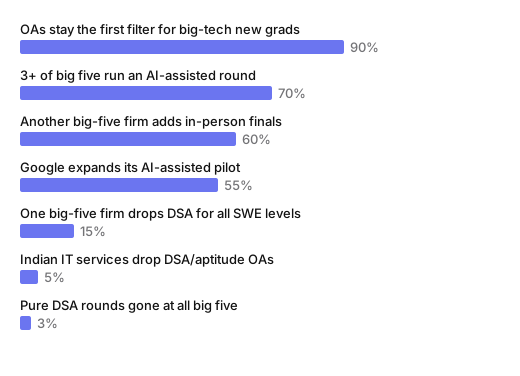
An AI-assisted round becoming standard within a year is likely. LeetCode-style rounds disappearing is not. Source: my estimates, Oct 2026, based on the sources below.
Here's what that means for you as a candidate. The middle column is the chance that a typical company in that tier, interviewing you in the next twelve months, has at least one LeetCode-style round somewhere in the process, online assessment included.
| Company tier | Chance of a LeetCode-style round | What sits next to it or replaces it |
|---|---|---|
| Big Tech (Google, Meta, Amazon, Microsoft, Apple) | ~90% | AI-assisted codebase round, in-person or proctored finals, system design for mid level and up |
| Large product companies and late-stage unicorns | ~65% | Vendor AI-assisted assessments (HackerRank, CoderPad, Karat), practical coding, take-homes |
| Indian product companies hiring at scale | ~85% | Online DSA test as the filter, then machine coding and system design |
| Indian IT services and campus mass hiring | ~95% | Aptitude plus DSA online tests, little change expected |
| Series A to C startups | ~40% | Build-with-AI rounds on screen share, take-homes, debugging real code |
| Seed and pre-seed startups | ~20% | Portfolio and shipped work, paid trial days or weeks, founder conversation |
The startup rows are the weakest numbers here. I couldn't find any survey that measures startup interview formats by stage. Those rows rest on The Pragmatic Engineer's reports that many startups dropped algorithm questions, on examples like Linear's paid work trials, and on how founders like Musk describe hiring. Read them as a direction, not a measurement.
What would change my mind
- Google publishes an AI-allowed policy on its careers site. That would push "3+ of big five" above 85 percent and drag large product companies along within months.
- Meta removes its last traditional round for E6 and below. That would move "one big-five firm drops DSA for all levels" from 15 to around 60 percent.
- Assessment vendors make AI-assisted tests their default product. HackerRank's Chakra launch points this way. Mid-size companies buy whatever the vendor ships, so this is the fastest route to change outside Big Tech.
- A cheating scandal or fraud wave at a large firm. This pushes toward in-person rounds, which tend to keep classic algorithm questions because they're easy to run on a whiteboard.
What I'd actually do right now
Don't stop preparing for algorithm rounds. Also don't keep grinding them as your only plan.
The online assessment is still the gate at Big Tech and most Indian companies, so you need medium-level fluency in the common patterns: arrays and hashing, two pointers, sliding window, trees, graphs with BFS and DFS, heaps, and basic dynamic programming. Past a few hundred problems the extra return gets small, because the new rounds test something else.
That something else is working in code you didn't write, with an AI assistant, and checking what it gives you. Meta's round hands you a multi-file codebase, asks you to build a feature, extend partial code, or fix a bug, and scores how well you verify and debug. Canva says candidates with little AI experience struggled even when they could code. You can practice this directly. Clone an unfamiliar open-source repo, add a small feature with tests using Claude or Cursor, and make sure you can explain every line you kept and every suggestion you threw out.
For startups, shipped work decides it. Musk's three-bullet email is the extreme version of what most early-stage founders want. Two or three projects that real people use, each with a public repo and a short write-up of the hard decisions, will beat a LeetCode count at a seed-stage company.
How you split your time depends on where you're applying. Aiming at Big Tech or Indian product companies? Roughly half on algorithm patterns, a quarter on AI-assisted codebase practice, and a quarter on system design or projects. Aiming at startups? Flip it. About a fifth on algorithms and the rest on building and AI-assisted work. That split is my judgment call from the round formats above, not a measured result.
Sources
- Engineering Interviews in 2026: 3 Trends Hiring Leaders Must Prepare For, Karat, Jan 2026
- The Pulse #146: How AI is changing tech interviews, The Pragmatic Engineer, 2025
- Yes, you can use AI in our interviews, Canva Engineering Blog, Jun 11, 2025
- Inside Meta's New AI-Enabled Coding Round, DG Learning, 2025
- Google's AI-Assisted Coding Interview (2026 Guide), University of Miami Career Services, May 14, 2026
- Companies That Allow AI in Interviews (2026 Sourced List), Copilot Interview, checked Oct 14, 2026
- HackerRank apologizes for the LeetCode grind as it sells AI-era interviews, RuntimeWire, Oct 12, 2026
- Google Reinstates In-Person Job Interviews Amid Rising AI Cheating Concerns, CXO Digital Pulse, Aug 26, 2025
- Anthropic changes its AI hiring policy, Fortune, Jul 21, 2025
- Fake job candidates and AI, HR Dive, Aug 8, 2025
- The SignalFire State of Tech Talent Report 2025, SignalFire, May 2025
- Elon Musk Is Personally Reading All SpaceX Job Applications, Entrepreneur, May 22, 2026
- 'Don't look at the résumé': Elon Musk on hiring, Fortune, Jun 27, 2026